Beauty & The Beast
by Nicole Wilk
Plot
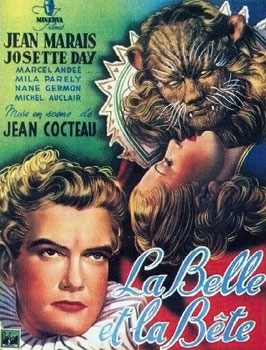
La Belle at la Bete follows the traditional European version of Beauty and the Beast, that is to say Belle has greedy siblings and asks her father to bring her but a rose back from his travels. The rose was plucked from the Beast's garden and he demands retribution. Belle moves into the castle, which is enamored with magic. But her father gets ill with worry and she is released by the Beast to go to him. The siblings want the riches from the castle and trick Belle into staying longer, stealing her magical items. It's only when she fears for the Beast's life that she realizes she loves him. In this version the curse of the Beast doesn't get lifted but transferred to a dying man.
Opening scene, taken direct from the
script.
OPENING TITLE:

Children believe what we tell them.
They have complete faith in us.
They believe that a rose plucked
from a garden can bring drama to
a family. They believe that the
hands of a human beast will smoke
when he kills a victim, and that
this beast will be shamed when
confronted by a young girl. They
believe in a thousand other simple
things. I ask of you a little of
this childlike simplicity, and to
bring us luck let me speak four
truly magic words, childhood's
Open Sesame:


   "Once upon a time..."
Technical Specifications
The film was released in 1946, France under the director, Jean Cocteau. The film was shot with 35 mm film, in black and white, and ran for a full 2544 metres, wiht an aspect ratio of 1.37 : 1. Cocteau was a pioneer in the film industry and his experimental nature with film has led to special effects of the day that were not matched by anyone. These included his use of the double exposure in such scenes as the magic mirror, Belle's teleportation to her house and to the castle, and the Beast's transformation to man. In order to animate the castle in real life the use of limbs were commonly holding up chandeliers, and being the centerpiece to tables. Living statues also littered the movie with busts in the fireplace, and arrow-shooting statues.
 |
| Double Exposure |
 |
| Double Exposure |
 |
| People as Props (movement) |
 |
| People as Props (movement) |
 |
| People as Props (movement) |
 |
| People as Props (movement) |
 |
| People as Props (movement) |
 |
| Make-up |
 |
| People as Props (movement) |
 |
| People as Props (movement) |
 |
| People as Props (movement) |
 |
| Layering |
 |
| Opening video, uses writing tools for credits |
 |
| People as Props (movement) |
 |
| Special Effect: Smoke |
 |
| Special Effect: Smoke |
 |
| People as Props (movement) / Special Effect: Smoke |
 |
| Special Effect: Smoke |
 |
| Special Effect: Smoke |
 |
| Make-up |
 |
| Make-up |
 |
| Double Exposure |
 |
| Double Exposure |
 |
| Special Effect: Lighting |
 |
| Special Effect: Lighting |
 |
| Reverse Motion |
 |
| Double Exposure |
 |
| Double Exposure |
 |
| People as Props (movement) |
 |
| Reverse Motion |
 |
| Reverse Motion / Special Effect Flying |
 |
| Reverse Motion / Special Effect Smoke |
This film made breaking ground for the animation of live-film. Characters transformed, stone came alive, characters teleported and flew, and others smoked. Although these techniques don't appear to be impressive now, they were immensely so 60 years ago. In fact, the effects aren't cheesy when viewed in the black and white context of the film. Overall, I believe this piece to be a wonderful example of creative thinking and ingenuity.